
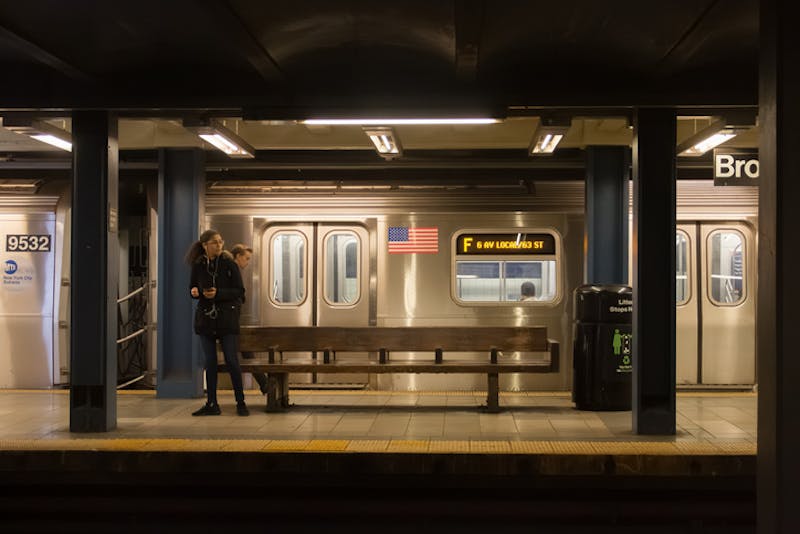
Far too many New Yorkers have suffered catastrophic injuries or lost their lives on subway tracks. In response, the MTA has installed what it calls "subway safety barriers," and by the end of June 2026, 158 stations had them. The short answer to whether they protect riders: not nearly enough. Scattered sections of railing leave much of the platform edge open, and the MTA has not shown the public that they are preventing serious injuries or deaths.
For Michael "The Bull" Lamonsoff, this issue hits close to home.
"I'm a native New Yorker. I was born and spent my formative years in East Flatbush, Brooklyn, and I built my firm right here. I know how much New Yorkers depend on the subway to get to work, to school, and home to their families. I also know how quickly an ordinary subway ride can turn into a tragedy."
-
Michael "The Bull" Lamonsoff
The Law Offices of Michael S. Lamonsoff has seen that devastation firsthand. The firm represents passengers and workers who suffered life-changing injuries after falling onto the tracks or being struck by trains, as well as families who lost loved ones in these accidents. That experience is why the firm has serious concerns about the MTA's approach to platform safety.
What Are the MTA's Subway Platform Barriers?
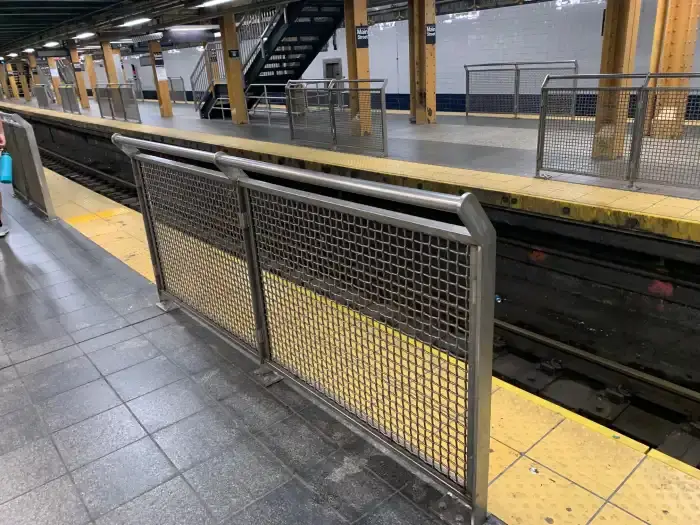
The MTA's platform barriers are sections of waist-high metal railing installed near the platform edge at select stations. If you ride the subway, you have probably seen them by now. They sound reassuring on paper, but on the platform the problems are easy to spot:
-
Wide gaps: Railing sections are spaced so far apart that much of the platform edge remains exposed.
-
Inconsistent coverage: You can stand behind a railing in one spot, walk a few feet, and find the tracks completely open.
-
No coverage data: The MTA reports how many stations have barriers, not how much of each platform edge they actually protect.
A station can count as having "barriers" while most of its platform edge looks exactly as it did before.
Can Partial Barriers Make Subway Platforms More Dangerous?
Yes. In some situations, partial barriers can increase the risk they are meant to reduce. When a railing is set back from the platform edge, it can create a narrow waiting area on the most dangerous side of the barrier, between the railing and the tracks. Passengers standing there have little room to recover if they stumble, lose their balance, faint, or are shoved.
There have also been reports of riders treating the barriers like hurdles, jumping over them to catch a train before the doors close. In those moments, equipment meant to protect riders becomes another obstacle near a live track.
Labeling a station as protected can also create a false sense of security. Passengers may assume they are safe when large stretches of the platform remain completely open. As our attorneys explain in Can You Sue the MTA and NYCTA for a Subway Track Accident, a safety measure that does not stop foreseeable harm can itself become a hazard.
What Does the MTA's 11% Reduction Really Mean?
The MTA reports an 11% decrease in accidental or unintentional track trespassing incidents at stations with barriers, based on a comparison of incidents before and after installation. That number raises more questions than it answers:
-
How many incidents occurred at those stations before and after the barriers went in?
-
What time period did the MTA measure, and is it long enough to be meaningful?
-
Have serious injuries and deaths at those stations actually declined?
-
How much of each platform edge did the barriers cover at the stations studied?
Without those answers, riders have no way to judge whether an 11% figure reflects real protection or a statistical blip.
How Often Do People End Up on NYC Subway Tracks?
Track intrusions remain a daily reality on the New York City subway. According to MTA figures reported by Route Fifty, there were 491 track intrusions during the first four months of 2026, only slightly below the 505 recorded during the same period in 2025, even as barrier installations expanded.
Passengers can faint, stumble, lose their balance, or be shoved onto the tracks without warning. Some suffer terrible injuries from the fall itself. Others are struck by trains, with catastrophic and sometimes fatal consequences. For the families our firm represents, these dangers are not hypothetical.
What Happened to Platform Screen Doors?
Platform screen doors separate waiting passengers from the tracks and open only when a train is properly positioned for boarding. Installing them throughout New York's aging subway system would be difficult. The MTA's own study concluded that full-height screen doors would be possible at only 27% of stations, at a cost of $7 billion.
Difficult is not the same as impossible. Following the 2022 death of Michelle Go, who was pushed in front of a subway train, the MTA announced plans to test screen doors at three stations. Yet Gothamist reported in October 2026 that those tests never happened. For a closer look at how other transit systems protect riders, see Why Are NYC Subways Getting More Dangerous?
What Should the MTA Tell New Yorkers About Platform Safety?
The MTA owes New Yorkers an explanation for why it never carried out the promised screen door pilot, along with a serious plan for improving platform protection. At a minimum, the agency should disclose:
-
How much of each platform edge its existing barriers actually cover
-
How it selects stations and installation locations
-
Raw incident counts, injuries, and deaths before and after installation
-
Its timeline for testing or installing platform screen doors where feasible
The number of stations that have received railings matters far less than whether those railings are keeping people off the tracks.
What Should You Do After a Subway Track Accident?
If someone falls onto the tracks, call 911, stay on the platform, and alert an MTA employee. A Help Point intercom can also summon assistance. Never climb down to the tracks.
After receiving medical attention, preserve witness information, photographs, the location and time of the accident, and any incident report number. Surveillance footage and train operating records can be critical, and footage may be overwritten quickly.
Time limits are strict. For many personal injury claims against the New York City Transit Authority, a Notice of Claim must be served within 90 days. Separate deadlines apply to lawsuits, and wrongful death claims have different requirements. For a full walkthrough, see How to File a Subway Track Accident Claim: A Step-by-Step Legal Guide.
Michael "The Bull" Lamonsoff's Experience With Catastrophic Injury Cases
Michael "The Bull" Lamonsoff has spent more than three decades fighting for New Yorkers whose lives were changed in an instant. Since founding his firm in 1994, he has built a team with more than 150 years of combined litigation experience and recovered over a billion dollars in verdicts and settlements. He is licensed in all New York State courts and the Federal District Courts for the Southern and Eastern Districts of New York, and his many million-dollar and multi-million-dollar results earned him membership in the Million Dollar and Multi-Million Dollar Advocates Forums.
His catastrophic injury results include:
-
$37,000,000 for an elevator mechanic who fell 25 feet into a concrete pit and suffered spinal injuries that left him quadriplegic
-
$12,157,000 for clients injured in a train derailment
-
$7,000,000 settlement during jury selection for a construction worker who suffered serious spinal injuries and a traumatic brain injury
-
$5,000,000 for a woman who tripped on a loose plate on the platform at the Yankee Stadium 4 train station, suffering a broken ankle and bone infection that led to a partial amputation
-
$4,800,000 settlement at trial for a construction mason whose traumatic brain injury his prior lawyers had failed to allege
Michael "The Bull" Lamonsoff and his team also currently represent New Yorkers who have suffered amputations, traumatic brain injuries, and other catastrophic harm after being struck by MTA trains.
Speak With a NYC Subway Track Accident Lawyer
New Yorkers should not have to rely on luck, or on where they happen to be standing, to avoid falling onto subway tracks. The MTA needs to show that its barriers provide meaningful protection rather than simply announcing how many stations have them.
Michael "The Bull" Lamonsoff and his team currently represent New Yorkers who have suffered amputations, traumatic brain injuries, and other catastrophic harm after being struck by MTA trains. The firm offers free consultations, is available 24/7, and moves quickly to secure footage and witnesses before evidence disappears.
If you were seriously injured or lost a loved one in a New York City subway track accident, call Michael "The Bull" Lamonsoff and his team at 212-962-1020.
The Law Offices of Michael S. Lamonsoff, PLLC 32 Old Slip, 8th Floor, New York, NY 10005
Attorney Advertising. The information on this page is provided for general educational purposes only and does not constitute legal advice. Every case is different. Past results do not guarantee future outcomes.