
On the night of March 22, 2026, Air Canada Flight 8646 collided with a Port Authority fire truck while landing at New York’s LaGuardia Airport, killing both pilots and injuring more than 40 passengers, crew members, and emergency personnel. The crash has shut down one of the busiest airports in the New York metropolitan area and triggered investigations by the National Transportation Safety Board (NTSB), the Federal Aviation Administration (FAA), and the Port Authority of New York and New Jersey.
The incident is already raising serious questions about air traffic control staffing, runway crossing procedures, and whether systemic failures in the U.S. aviation system contributed to this tragedy.
What Happened at LaGuardia Airport
Air Canada Flight 8646, a Bombardier CRJ-900 operated by Jazz Aviation (Air Canada’s regional partner), departed from Montréal-Trudeau International Airport shortly after 10:30 p.m. ET and arrived at LaGuardia roughly an hour later. The aircraft was carrying 72 passengers and four crew members, including the captain, first officer, and two flight attendants.
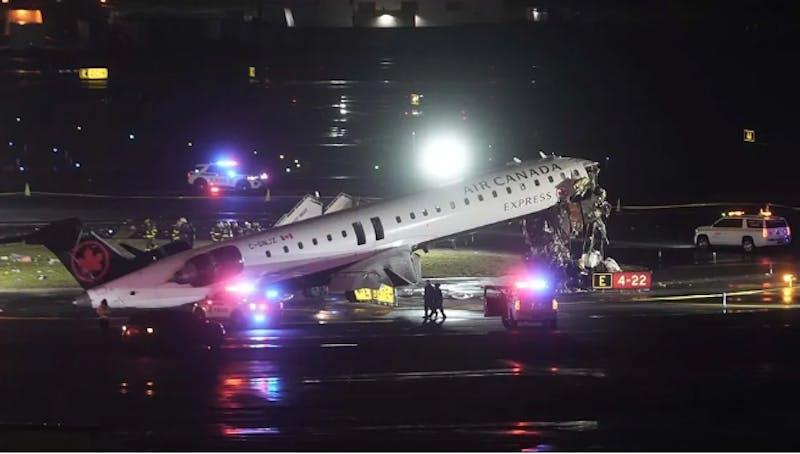
At approximately 11:40 p.m. ET, as the jet was completing its landing roll on Runway 4, it struck a Port Authority Aircraft Rescue and Firefighting (ARFF) vehicle that was crossing the runway. The fire truck had been responding to a completely separate incident: United Airlines Flight 2384 had aborted its takeoff after a warning light activated and crew members reported an unusual odor in the cabin that was making flight attendants ill.
The collision was devastating. Photos from the scene show the front of the aircraft destroyed, with the cockpit area described by one reporter as “disintegrated.” The fire truck was found overturned on its side off the runway. Both pilots were killed. Forty-one people, including passengers, crew, and two Port Authority police officers aboard the fire truck, were transported to local hospitals. As of Monday morning, nine remained hospitalized with serious injuries, while 32 had been released. One flight attendant was found outside the aircraft still strapped in her seat.
Air Traffic Control Audio Points to Critical Breakdown
Air traffic control recordings captured the moments leading up to the collision and have become a central focus of early reporting. The audio indicates that the controller cleared the ARFF vehicle to cross Runway 4 at Taxiway D while Flight 8646 was still on its landing roll. Moments later, the same controller frantically attempted to rescind the clearance, repeatedly shouting for the truck to stop.
In the aftermath, a Frontier Airlines pilot waiting on the ground who witnessed the collision radioed in. The controller, audibly distressed, acknowledged the situation and was recorded saying he had been managing a simultaneous emergency and had made an error. A Frontier pilot responded with words of support.
U.S. Transportation Secretary Sean Duffy confirmed that his office is investigating whether air traffic control staffing levels played a role. Preliminary reports suggest that a single controller may have been responsible for both runway and ground operations at the time of the crash, a configuration that, while permitted during lower-traffic periods, is now under scrutiny. LaGuardia’s control tower is rated among the FAA’s highest-complexity facilities (11 out of 12), and the broader U.S. air traffic control system has faced well-documented staffing shortages, with controllers routinely working six-day weeks of 10-hour shifts.
The Investigation Ahead
The NTSB has deployed a “go team” to the site and is leading the investigation. The FAA is assisting, and Canada’s Transportation Safety Board has also sent investigators, since the aircraft was operated by a Canadian carrier. Former NTSB Chair Robert Sumwalt has estimated the full investigation could take 12 to 18 months.
Investigators will examine air traffic control recordings and radar data, the aircraft’s cockpit voice recorder and flight data recorder, airport surveillance footage (which has already been turned over to the NTSB), witness statements from passengers, crew, and controllers, weather conditions at the time (light rain and fog had been reported earlier in the evening), and runway crossing procedures and whether existing protocols were followed.
Aviation safety experts have noted that while runway crossings by emergency vehicles are routine, they depend on precise timing and coordination. LaGuardia’s tight layout leaves little margin for error, and the combination of an active emergency response, reduced nighttime staffing, and adverse weather may have created conditions where a single mistake became catastrophic.
Wider Impact on Air Travel
LaGuardia Airport, which served more than 30 million passengers in 2025, was closed immediately after the collision and is not expected to reopen until at least 2 p.m. on Monday, March 23. More than 500 flights have already been canceled. The closure compounded existing travel disruptions, as a brief ground stop was also issued at nearby Newark Liberty International Airport on Monday morning after controllers evacuated the tower due to a burning smell in an elevator.
The crash is the first fatal incident involving an Air Canada flight in more than 40 years, dating back to Air Canada Flight 797 in 1983. It adds to a troubling series of aviation safety incidents in the United States, following the midair collision between a passenger jet and a military helicopter near Washington, D.C. in January 2025 that killed 67 people.
Legal Rights of Victims and Their Families
Aviation accidents like the LaGuardia collision involve layers of legal complexity that set them apart from other personal injury cases. Multiple parties may bear liability, federal and international regulations come into play, and the airlines and their insurers will deploy significant resources to limit their exposure.
In this case, potential sources of liability could include air traffic control negligence (if the controller improperly cleared the fire truck to cross the active runway), the Port Authority of New York and New Jersey (as the operator of the ARFF vehicle and the entity responsible for ground operations), the airline and its regional operator, Jazz Aviation (depending on what the investigation reveals about pilot actions and aircraft condition), and the FAA itself (if systemic understaffing contributed to the conditions that led to the crash).
Because this flight originated in Canada, the Montreal Convention may also apply, governing compensation for passengers on international flights. Under the Convention, airlines face automatic liability up to approximately 135,000 Special Drawing Rights (around $135,000 USD) per passenger, with additional compensation available if negligence is proven.
Passengers who were injured, as well as the families of the two pilots who were killed, may be entitled to compensation for medical expenses, lost wages and future earning potential, pain and suffering, emotional distress, loss of companionship, and, in cases of extreme negligence, punitive damages. For a comprehensive overview of how aviation accident claims work in New York, visit our New York Plane Accident Lawyer page.
Why Victims Need an Experienced Aviation Accident Attorney
Aviation litigation is not like a standard car accident case. It requires attorneys who understand federal aviation regulations, NTSB investigative processes, the Montreal Convention, and how to navigate claims involving government entities, international carriers, and multiple potentially liable parties. Evidence preservation is also time-sensitive: cockpit voice recorders, flight data recorders, maintenance logs, and air traffic control records must be secured before they are overwritten or lost.
At The Law Offices of Michael S. Lamonsoff, PLLC, we have direct experience litigating high-profile aviation disaster cases, including representing families of victims of American Airlines Flight 587, one of the deadliest aviation accidents in U.S. history. Michael S. Lamonsoff, known as “The Bull,” has built a reputation for taking on powerful airlines and insurers and securing substantial results for victims of catastrophic negligence.
If you or a loved one was aboard Air Canada Flight 8646 or was otherwise affected by the LaGuardia Airport crash, contact us immediately for a free consultation. Time is critical in aviation cases, and having the right legal team from the start can make a significant difference in the outcome of your claim. Call 212-962-1020 or contact us online.